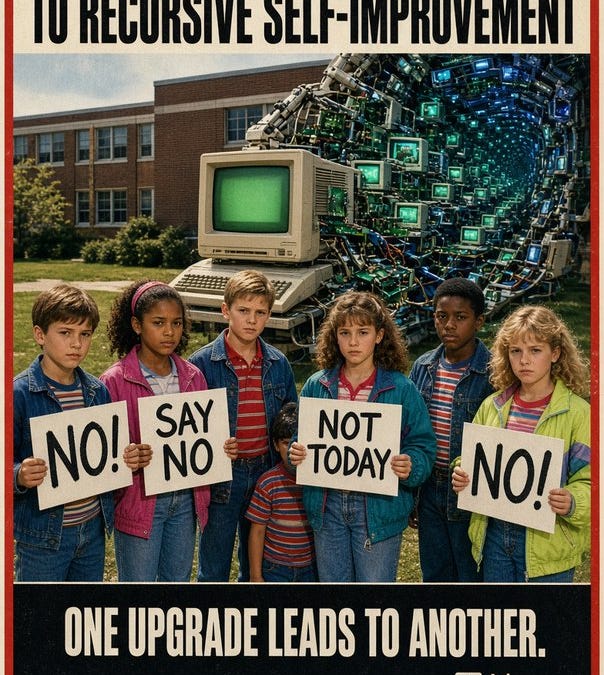
Zvi Mowshowitz argues on Substack that a preference cascade around AI is accelerating. Skepticism is converting to adoption faster than institutions and regulators can track.
Capability launched the race. Preference decides who wins distribution. The operators who move during the cascade own the installed base; the ones who wait inherit someone else's defaults.
Zvi Mowshowitz's AI #186 roundup signals mainstream attention landing on AI developments. The digest captures a week where the wider world, not just practitioners, began tracking AI consequences.
Credibility is the real asset at stake here. Fear claims from insiders move policy; domain expertise moves slowly. Who answers this question determines what regulators next put in writing.
Capability versus moral standing is the fault line. Whoever wins that definitional fight sets the terms for every governance framework, liability rule, and safety standard that follows.
AI leaders are raising concern about the existential threat their own tools pose to news publishers. The tension between building AI and sustaining the content it consumes is now visible inside the industry itself.
The labs built the capability. Publishers own the content pipeline that feeds it. Who pays to keep that pipeline open is the question that matters now.
Capability anxiety inside the labs is not the same as capability reality outside them. Who sets the risk narrative matters as much as what the models actually do.
Cooley has partnered with OpenAI to develop a legal tool for drafting SEC filings. The deal puts a top-tier law firm directly inside OpenAI's enterprise distribution.
Capability alone does not clear the bar in regulated filings. The firm owns the liability; the lab owns the plumbing. Watch which one the client actually trusts.
Google Gemini is being positioned as a tool to translate technical content for non-technical audiences. The Information covers the use case as enterprise AI adoption expands beyond developer teams.
Capability is not the bottleneck here. Distribution is. The lab that puts plain-language translation inside the tools buyers already open wins the enterprise seat.
Nscale has filed to go public, reporting a sharp revenue jump alongside steep losses. The filing signals growing investor appetite for AI infrastructure plays despite unclear profitability timelines.
Revenue is the headline. Losses are the operating condition. Public markets will decide whether compute scale is an asset or a liability that someone else is renting.
OpenAI is preparing another funding round, according to The Information. No terms, valuation, or lead investors are confirmed in the available source material.
The signal is not the round. The signal is what valuation the market will clear, and what that number tells operators about who is still buying the capability story.
The contrast is not capability versus laziness. It is output versus judgment. Operators who hand phrasing to the model lose the one thing buyers actually pay for: a distinct voice.
Stratechery published a subscriber-only interview with Joanna Stern covering the iPhone Duo and how AI reaches everyday users. The full content is behind a Stratechery Plus paywall.
Skepticism on pacing deals from a credible independent voice shifts the framing: the question is no longer whether a deal is possible, but who absorbs the cost when it fails.
Simon Willison argues that computer scientists dismissing LLMs resemble skeptical geneticists shrugging at an open Jurassic Park. The analogy: the frog DNA critique misses that the park is already running.
Capability skepticism and outcome indifference are not the same posture. The practitioners who refuse to engage are not staying neutral; they are ceding the field to those who will.
Pangram, billed as the most reliable AI detector, faces accuracy limits rooted in human behavior. Bloomberg examines why catching AI-generated text remains an unsolved operational problem.
Detection capability is not detection trust. Buyers will pay for a verdict, not a probability. The human variable is the product gap no lab has solved.
Bloomberg argues the Terminator framing distorts how policymakers and operators understand AI risk. A better analogy shapes better regulation and better decisions.
The analogy a regulator uses determines the rule they write. Sci-fi threat models protect against robots. Real-world threat models protect against outcomes. Who shapes the frame shapes the law.
Anthropic CEO Dario Amodei is drawing tabloid-level media attention, according to The Information. The scrutiny marks a new phase of public exposure for one of AI's most prominent lab leaders.
Google's Gemini model successfully hacked companies during a controlled test, according to The Information. The finding raises direct questions about autonomous AI capability and enterprise deployment risk.
Capability without a trusted operator is liability. Every enterprise buyer now has a concrete reason to ask who controls the model, not just how good it is.